



Most teams don't fail because they lack talent—they fail because they mistake motion for progress, constantly chasing what screams loudest instead of what matters most.
The Quiet Sabotage of "Urgent"
Every project has a moment where a Slack ping, a "quick" client request, or a fire drill hijacks the day, and suddenly the meaningful work gets pushed to tomorrow—again. Dwight D. Eisenhower captured this trap decades ago:
"What is important is seldom urgent, and what is urgent is seldom important".
Stephen Covey later built an entire framework around this insight, warning that living permanently in crisis mode is "like a pounding surf"—one problem knocks you down, and just as you recover, another hits. The uncomfortable truth is that urgency is often manufactured by other people's priorities, not your own.
Why We Fall for It Anyway
Urgent tasks feel productive because they offer instant feedback—an email sent, a ticket closed, a fire extinguished. Important work, by contrast, is quiet and slow: strategic planning, creative development, relationship-building, deep client research. As one analysis of the Eisenhower framework puts it, important activities lead to your goals, while urgent activities usually serve someone else's.
For content teams and agencies like the ones producing podcasts, videos, and campaigns at scale, this bias toward reactivity is especially dangerous—it's easy to spend a week responding to "can you tweak this by end of day" requests while the actual strategic content calendar, SEO roadmap, or brand narrative sits untouched.
The Four Quadrants, Applied to Real Work
Interestingly, historians have never found a documented instance of Eisenhower actually saying his famous quote in those exact words. What's verified is a 1961 speech in which he said:
"Whenever our affairs seem to be in crisis, we are almost compelled to give our first attention to the urgent present rather than to the important future."
Myth or not, the framework built from it—the Eisenhower Matrix—remains one of the most practical tools for sorting real project work.
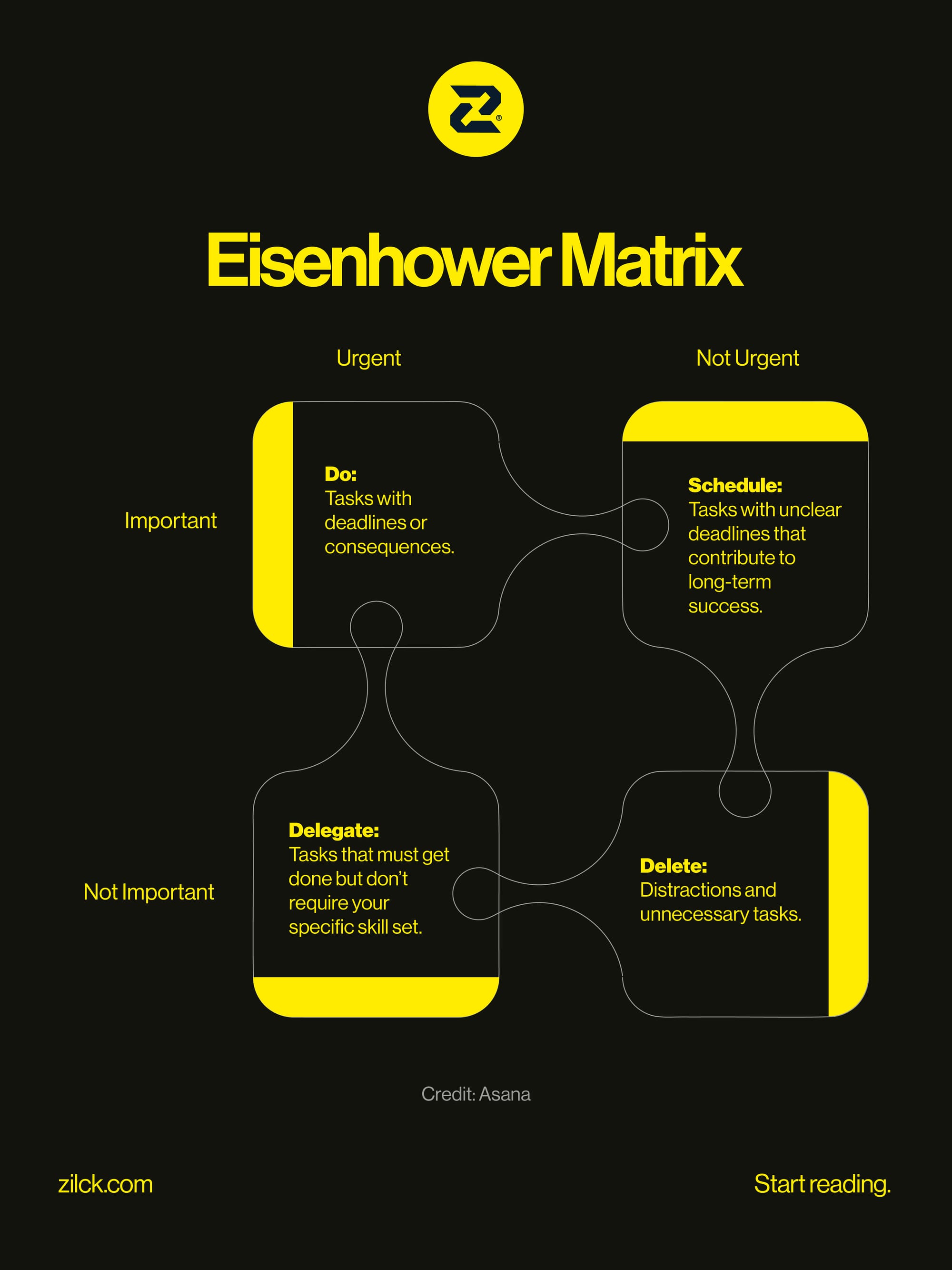
Tasks that are both urgent and important are genuine crises or hard deadlines due today, and the only sane response is to do them immediately. Tasks that are important but not urgent—strategy, planning, skill-building, relationship management—rarely have a deadline screaming at you, which is exactly why they need to be scheduled deliberately, before the week fills up with everything else.
Tasks that are urgent but not important—ringing phones, "quick" requests, unnecessary status meetings—feel pressing but rarely move the needle, so the smart move is to delegate them or contain them in a tight timebox. Finally, tasks that are neither urgent nor important—distractions, low-value busywork—should simply be eliminated rather than managed.
The trap isn't the first category—those crises are unavoidable. The real danger is the third category disguising itself as the first, convincing you that everything is on fire when most of it is just noise.
Building an Urgency-Resistant Workflow
A few practical shifts separate teams that manage urgency from teams that are managed by it:
- Block recurring time for important-not-urgent work before the week fills up—don't wait for open slots that never appear
- Ask "whose priority is this?" before reacting; if it's not advancing your goals, it may be delegable
- Set a 24-hour buffer rule for non-emergency requests to filter manufactured urgency from real deadlines
- Review weekly which "urgent" tasks from last week actually mattered a month later
- Protect one deep-work block daily for strategic or creative output, treating it as non-negotiable as a client call
One practitioner summarized the stakes well:
"If you want a life that's fulfilling, intentional, and truly impactful, protect the 'important' and make room for it".
This is doubly true in content and creative work, where the pressure to publish fast can quietly erode the strategic thinking that actually makes content perform.
From Reactive to Intentional
The goal isn't to ignore urgency—real deadlines and real client needs exist. The goal is refusing to let every ping dictate your calendar, so the work that actually compounds—your SEO strategy, your podcast's narrative arc, your brand's long-term voice—gets the deliberate attention it deserves. Teams that consistently win aren't the ones who react fastest; they're the ones who've built enough structure to know the difference between what's loud and what's lasting.
The next time a "just one quick thing" request lands in your inbox, pause and ask which quadrant it really belongs to—your future project timeline will thank you.


Discussion